
Some courses you admire from the outside; others wrap around you the moment you step onto the first tee. San Roque Golf & Resort is the second kind, and the trees of San Roque are the reason: vast canopies framing the greens, trunks that give the fairways their shape and a shade that stays with you from the first hole to the last. Playing among them, with the Mediterranean breeze for company, is a privilege best understood one shot at a time.
It is not only about beauty. The trees of San Roque are part of the course’s demanding design: they set the angles, hide flags and make you think before you draw a club from the bag. This is the round as the trees tell it.
The trees of San Roque set the line from the tee
We will meet you on the tee, and the first thing you see will not be the flag but the woodland. From there, the trees of San Roque work like a compass: they tell you where to aim your drive, which side of the fairway leaves the best second shot and where you would rather not end up.
When a canopy crowds the natural line of the hole, the drive stops being an automatic swing and becomes a decision. Do you take it over the tree, or play to the wide part of the fairway and leave yourself a longer iron? That question, asked hole after hole, is what turns a round into an open-air game of chess.
A green guarded by sand and woodland
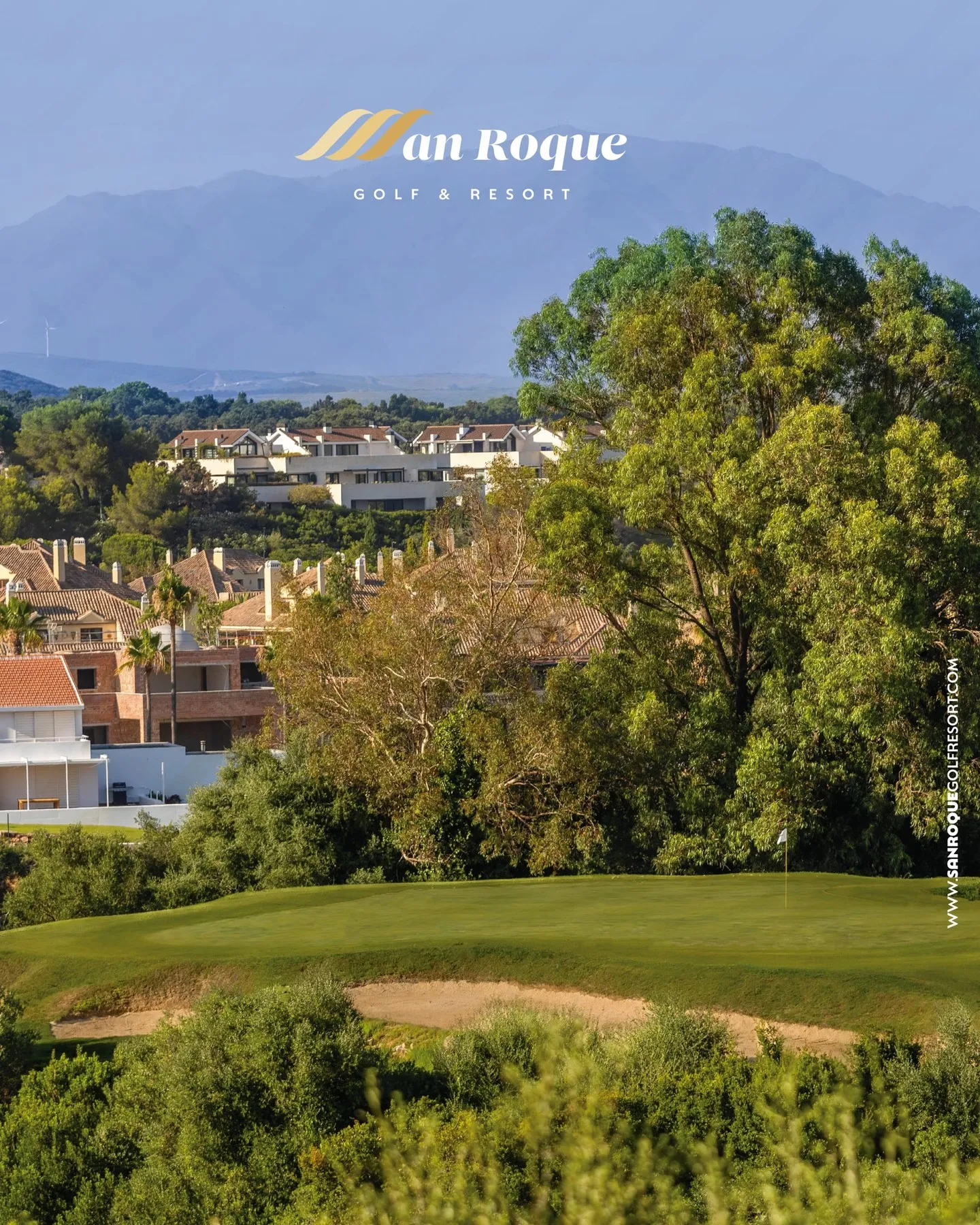
The cover image says it all. A gently sloping green, the white flag almost hidden at the back, a bunker protecting the front and, behind it, a wall of trees of San Roque closing it off like a stage curtain. Further on, white houses peer over the hillside and, in the distance, the bluish outline of the sierra.
On a green like this, the trees of San Roque serve as both scenery and reference. They help you judge depth when the flag disappears into the shadows, and they remind you that going long comes at a price. That is why the approach at San Roque asks for more than distance: it asks you to read the back of the green, choose your height and trust your swing.
A cork oak that tells the story of the estate
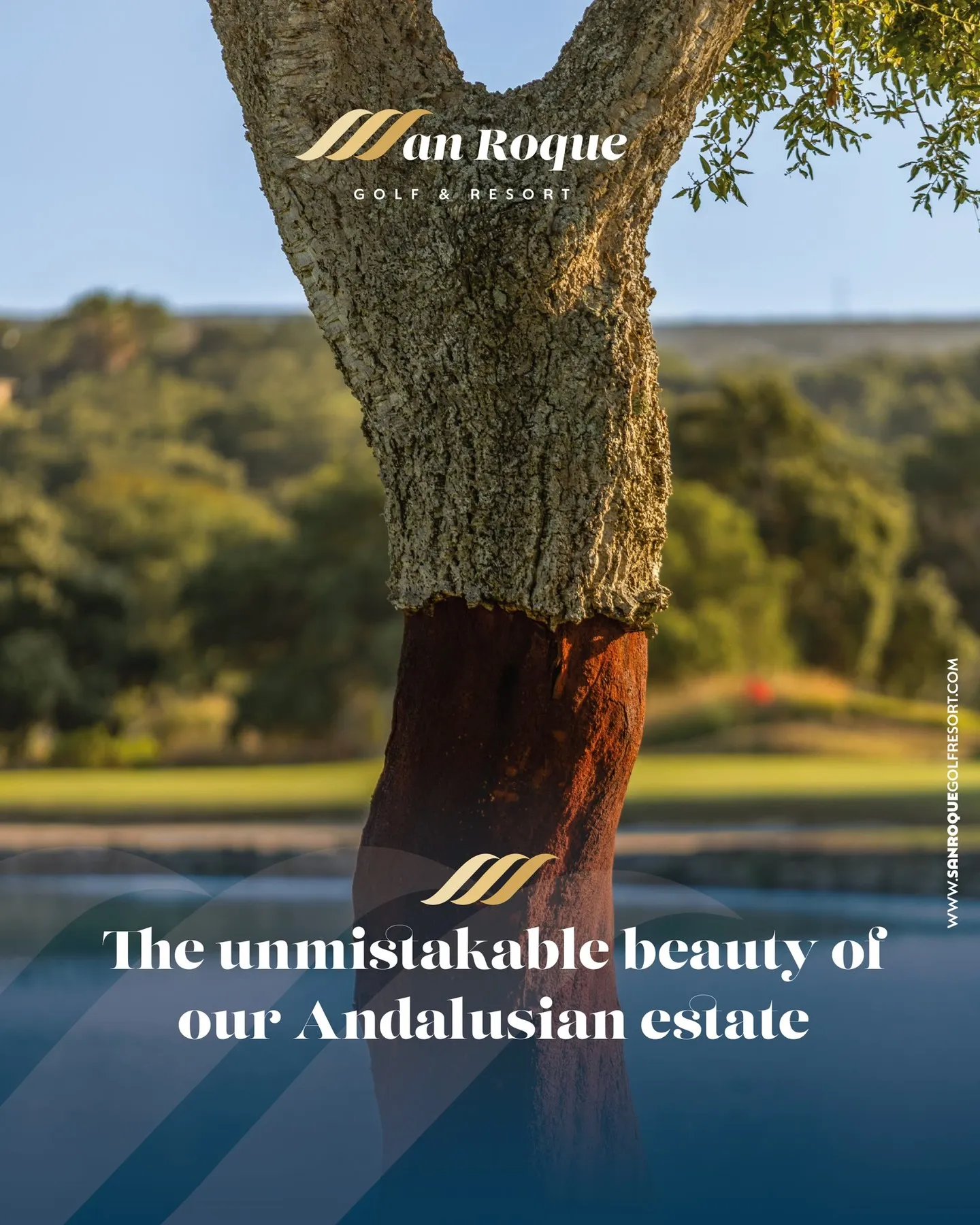
Among the trees of San Roque there are specimens that speak of the place without needing a sign. This cork oak is one of them: the upper half of the trunk keeps its grey, rugged bark, while the lower half shows the reddish tone revealed when the cork is harvested. It is the timeless landscape of southern Andalusia, set right in the heart of the course.
Behind it, out of focus, the course takes shape: the green fairway, a gentle hillside and water in the foreground. That blend of Mediterranean woodland and immaculate golf is what gives the estate its character, and what makes every round feel a little like a walk through the countryside.
The Mediterranean breeze comes into play
The breeze rolling in from the Mediterranean is the other half of the experience. It cools the morning, stirs the canopies and, above all, changes the flight of the ball. Among the trees of San Roque the wind is felt unevenly: on a sheltered tee it seems perfectly still, and then, out on the open fairway, it pushes with real intent.
That is why it pays to look up before every shot. The leaves on the tallest canopies are the best anemometer on the course, telling you what awaits at the height your ball will travel. That small habit is what separates a well-judged shot from one that ends up in the trees.
A demanding design with views worth pausing for
San Roque Golf & Resort brings together nature, demanding design and spectacular views on a single course, in the Campo de Gibraltar and just a short drive from the Costa del Sol. The legacy of Seve and Perry Dye shows in the way the course challenges you without ever ceasing to be a pleasure to play.
Between holes, it is worth stopping for a moment. Wooded hillsides, the sierra on the horizon and light filtering through the branches compose a postcard that changes as the day goes on. The trees of San Roque do more than offer shade: they set the rhythm of the round and turn every walk between greens into part of the experience.
How to read the trees of San Roque on your next round
If you are playing here for the first time, think of the trees of San Roque as an ally rather than an obstacle. From the tee, pick the side of the fairway that leaves you a clean line to the green, even if it means giving up a few metres. And when a canopy gets in the way, always weigh up the safe option: chipping back to the fairway costs one shot, while going for the miracle usually costs more.
Use the trees of San Roque as a visual reference for aiming and judging distance, too, and watch how their branches move before you choose a club. Keep those three ideas in mind and the round becomes more enjoyable, and your scorecard will thank you.
Frequently asked questions
Why do some cork oaks have a reddish trunk?
Because their cork has been harvested. The bark is stripped without felling the tree and, once removed, it reveals a reddish layer that gradually covers over again with time.
What should I do if a tree blocks my line to the green?
The sensible choice is usually to punch the ball back to the fairway with a low, controlled shot. Trying to go over or through the branches multiplies the risk of ending up worse off than before.
How can I tell which way the breeze is blowing on the course?
Look at the tallest canopies of the trees of San Roque before every shot. Their movement shows you the real wind at the height your ball travels, which does not always match what you feel on the tee.
Where is San Roque Golf & Resort?
In San Roque, in the province of Cádiz, in the heart of the Campo de Gibraltar and just minutes from the Costa del Sol.