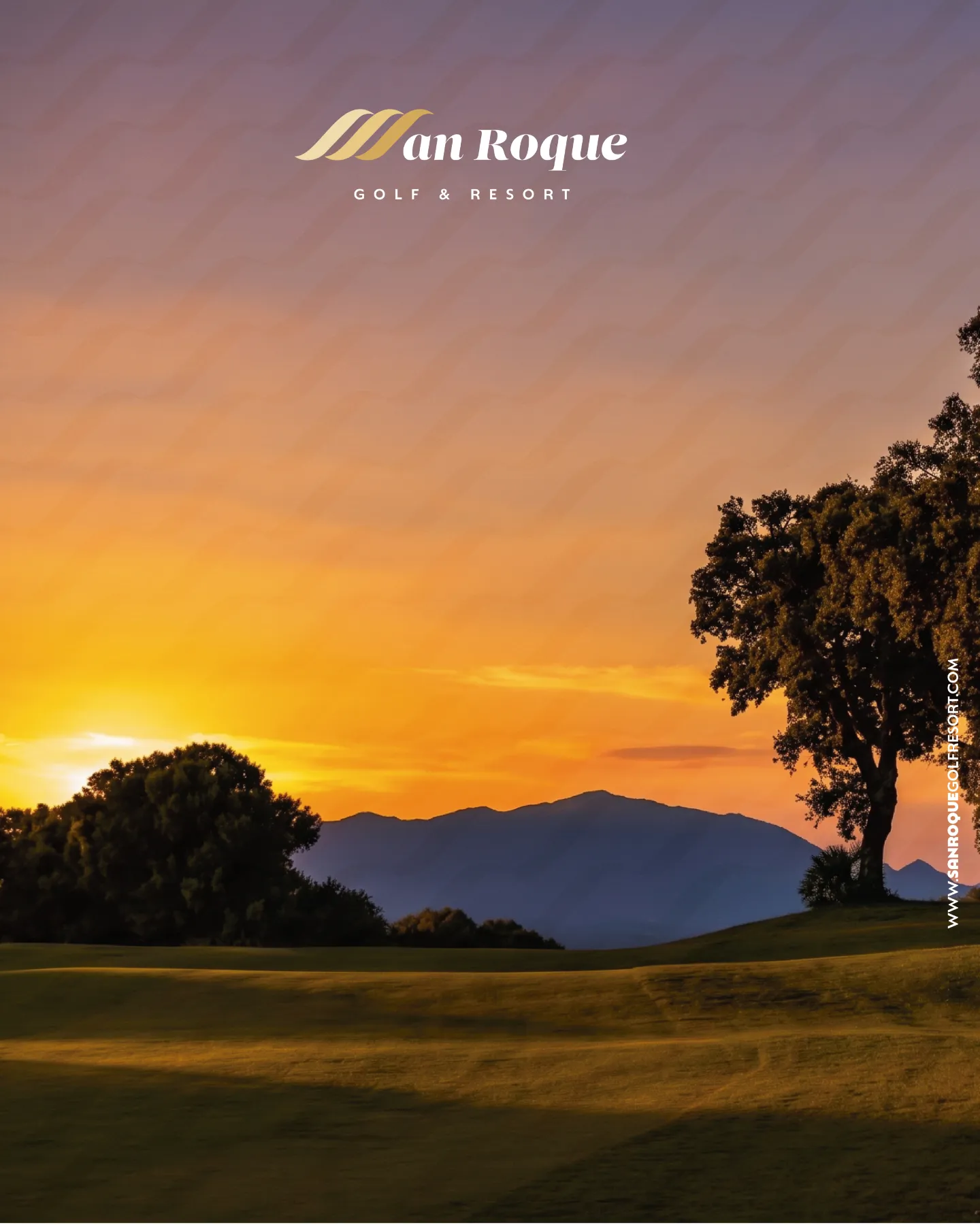
There is an hour when the San Roque landscape stops being scenery and becomes part of the game. The sun drops behind the tree line, the sierra is cut out in blue at the back and the fairway falls into half-light while the sky turns orange. That is how the week says goodbye at San Roque Golf & Resort: the course in silence and the light handing out long shadows over the grass.
You do not need to see a flag to know where you are. It is enough to look at how the ground rolls, how the cork oaks stand in the middle of the route and how the woodland reaches the edge of the rough without asking permission. That continuity between course and countryside is the signature of the San Roque landscape.
The fairways merge into the cork oak wood
The integration does not show on one particular hole, but in the invisible seam between what was designed and what was already there. The fairways rise and fall following the natural relief, they go around the trees instead of moving them aside and they let the native vegetation of the Campo de Gibraltar mark the limits of play. That is the trait that defines the San Roque landscape: a course that seems to have grown with the wood rather than been imposed on it.
The balance also changes how you play. When a cork oak defines the angle of attack into the green, the tee shot stops being automatic and turns into a decision. And when the fairway narrows between two blocks of woodland, it is worth reading the San Roque landscape before pulling a club out of the bag.
The contrast of the vegetation orders what you see
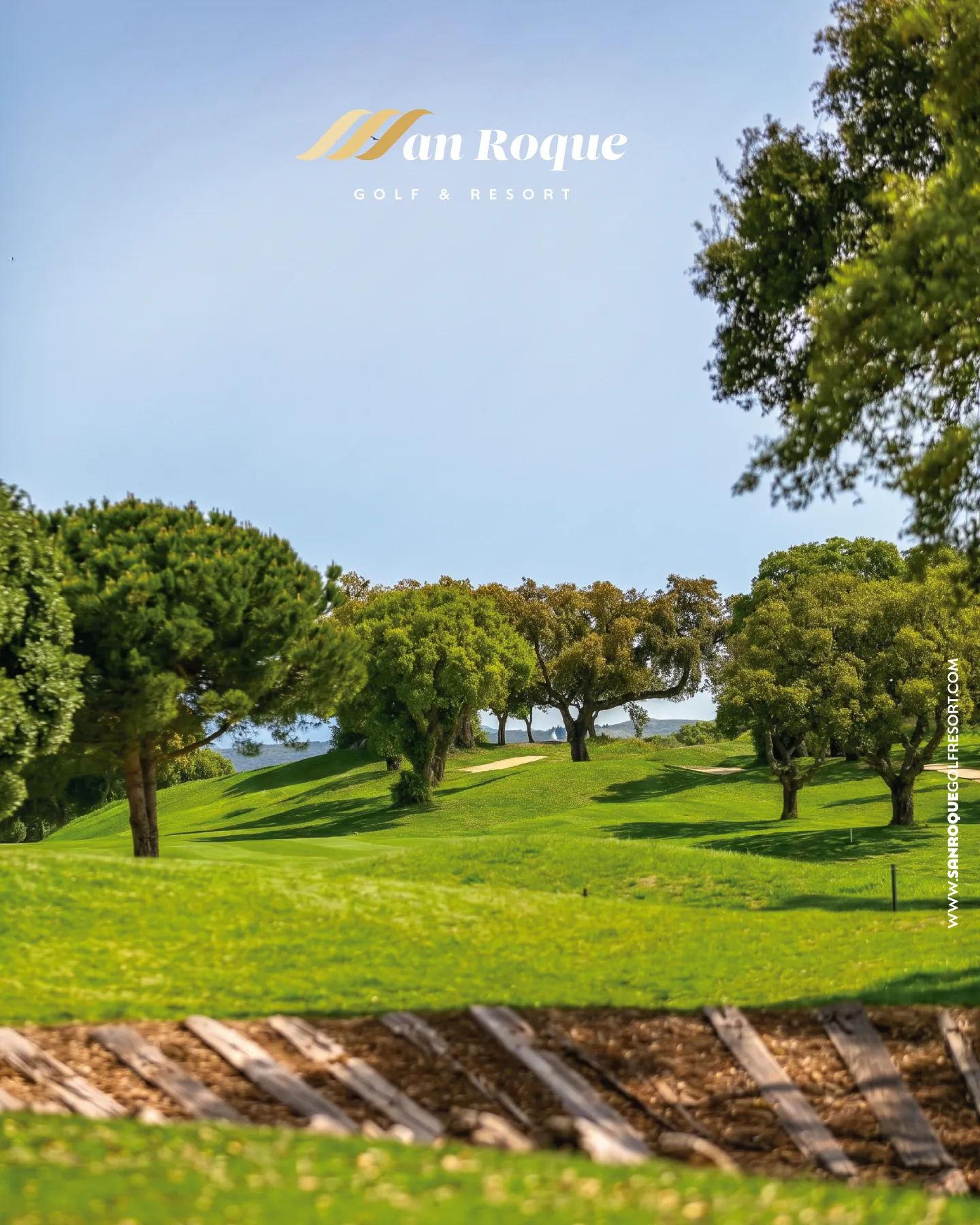
The second distinctive trait is about colour. The short green of the fairway contrasts with the deep green of the canopies, with the ochre of the sand in the bunkers and with the timber of the sleepers that frame the paths. Seen from a rise, they are layers that work like a painting in planes: ground, trees, sierra and sea.
That contrast is not only aesthetic: it helps you calculate. The difference in tone between fairway, rough and wood draws where the safe zone ends, and the white of the sand works as a reference when the green hides behind a rise. In the San Roque landscape, your eyes work as hard as your swing.
The sea appears between ravines and rises
The route runs over 45 hectares of ground modelled beside the ocean and a protected nature reserve, and that double condition marks the San Roque landscape on every stretch. There are holes played over wooded ravines, where missing the green is expensive, and there are tees with the sea behind, like the one on the 7th.
That alternation stops the round from turning monotonous. You go from an open, bright fairway to a corridor closed in by trees, from the blue of the horizon to the dense shade of the wood. The San Roque landscape changes register every few holes and forces you to readjust your strategy just as often.
The Perry Dye and Severiano Ballesteros design respects the ground
The 18 holes carry the signature of Perry Dye and Severiano Ballesteros, and that authorship explains a good part of what you see. Dye works with the movement of the ground and with bunkers that appear where they bother you most; Seve understood golf as a conversation with the surroundings. From that crossing comes a demanding course that never looks artificial.
There are rolling greens that punish the long putt, deep bunkers around raised platforms and fairways with slopes that feed the ball back to the middle if you pick the right side. All of it without cutting back the wood or flattening the rises: the course adapted to the San Roque landscape, and not the other way round.
The San Roque landscape looks its best late in the afternoon
If one plan sums up the spirit of the resort, it is a tee time at the end of the day. The low light stretches the shadows of the trees across the fairway, the sky goes from gold to violet and the temperature invites you to stay out one hole longer than you should. It is the natural way to close the week.
That hour also reveals details that midday flattens: the relief of the ground, the silhouette of each tree against the horizon and the profile of the sierra at the back. Whoever plays at sunset discovers another version of the route, quieter and more scenic; whoever simply walks the San Roque landscape at that hour takes home the best postcard in the Campo de Gibraltar.
Golf a step away from the Costa del Sol and Gibraltar
The course is in San Roque, province of Cádiz, in the heart of the Campo de Gibraltar and a few minutes from the Costa del Sol. That location lets you combine a morning round with beach, food or mountains in the afternoon, without long drives, and the mild climate stretches the season across the whole year.
For anyone coming for the first time, the advice is simple: book ahead, play the opening holes slowly and let the San Roque landscape explain the course to you. You learn more by looking at the ground than by checking the yardage book.
Frequently asked questions
Is the course suitable for golfers of every level?
The club puts it this way: every hole aims to offer a memorable experience at any standard of play, although the rolling greens and the deep bunkers reward the accurate golfer.
How do you book a tee time?
Through the online booking on the club’s website, where you choose day and time before arriving at the course.
Can you play all year round?
Yes. The mild climate of the Campo de Gibraltar lets you play in winter too, when the low light gets the most out of the surroundings.
Where exactly is the course?
In San Roque, province of Cádiz, inside the Campo de Gibraltar and a few minutes from the Costa del Sol.
What trees accompany the route?
Cork oaks and Mediterranean pines, above all: the woodland that belongs to the San Roque landscape is part of the playing strategy on almost every hole.